S
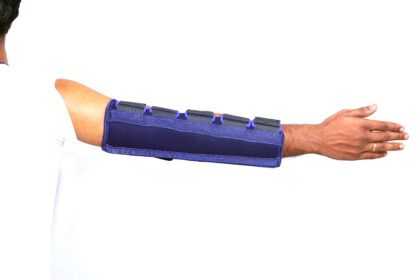
An Elbow ROM (Range of Motion) Brace is a hinged orthotic device designed for post-surgical recovery or trauma rehabilitation. It allows clinicians to set precise limits on joint movement to protect healing ligaments, tendons, or fractures.
Key Product Specifications (2026)
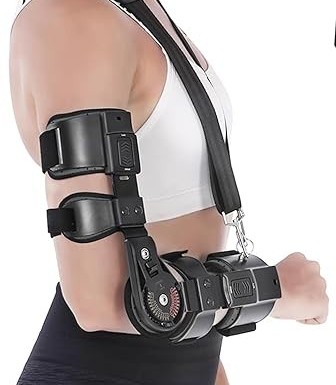
- Dial Control Mechanism: Features a sophisticated ROM hinge that allows for flexion and extension adjustments, typically in 10° to 15° increments.
- Flexion Range: Generally adjustable from 0° to 120°.
- Extension Range: Generally adjustable from 0° to 90°.
- Quick-Lock: Many models include a drop-lock or pin system to immediately immobilize the arm at specific angles (e.g., 0°, 15°, 30°, 45°, 60°, 75°, 90°).
- Telescopic Design: Most 2026 clinical models feature a telescoping frame with push-button length adjustments to customize the fit for different arm lengths (typically ranging from 34 cm to 43 cm or 13.5″ to 17″).
- Materials:
- Frame: High-strength, lightweight aluminum alloy or rigid plastic bars for structural stability.
- Lining: Breathable, moisture-wicking laminated foam or 3D cushion pads to reduce skin irritation during long-term wear.
- Weight: Highly portable and lightweight for user comfort, with average weights ranging from 400g to 560g.
- Closure & Security: Utilizes high-tension hook-and-loop (Velcro) straps and reverse-buckle systems to ensure the brace does not slip or rotate during activity.
Functional Features
- Integrated Sling: Often includes an adjustable neck/shoulder strap to help distribute the weight of the arm and prevent brace migration.
- Modular Components: Some high-end models feature removable armrests or hand grips to stabilize the forearm and improve joint alignment.
- Universal Fit: Most products are designed to be unisex and universal in size, though many are specific to either the left or right arm for optimal hinge alignment.
Therapeutic Indications
- Post-Operative: Ideal for recovery from rotator cuff or ligament repairs, tendon transfers, and ulnar nerve transposition.
- Trauma: Used for managing elbow dislocations, luxations, and stable fractures of the distal humerus, radius, or ulna.
- Chronic Care: Beneficial for managing severe elbow stiffness or instability.


Reviews
There are no reviews yet.